Dernière modification le 27/07/2026.
An ancient deity, Baphomet is an occult figure associated with the Knights Templar and the Freemasons.
Introduction
The origins of this idol, shrouded in mystery, can be found in the New Testament. It was in the 19th century that occultists began calling it Baphomet. Its association with the Knights Templar—whose members were accused of worshipping it—further cemented its legend. It is sometimes referred to as Bophomet.
Description
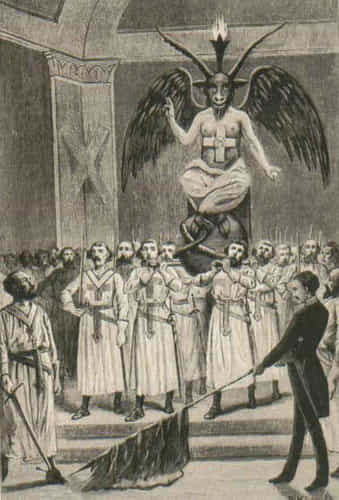
Although Baphomet had been depicted in earlier times, it was the French occultist Éliphas Lévi who gave him his most famous portrayal. Thus, Baphomet is depicted as a winged hermaphrodite with the head and hooves of a goat, a beard, and breasts. He is a very ugly figure whose mere sight is enough to terrify. Some even say that its head is far too hideous to be described.
When depicted in a more human form—often in Templar art—he is portrayed as a bearded man, sometimes with curly hair, whose face is said to be inspired by the one depicted on the Shroud of Turin.
On his forehead, he bears a pentagram and the caduceus on his stomach (a symbol of commerce and exchange associated with Hermes). He holds his right arm raised, with two fingers pointing toward the sky, and his left arm lowered, with two fingers pointing toward the ground. This signifies “as above, so below.” According to Éliphas Lévi, this gesture “expresses the perfect harmony of mercy with justice.”

History
The Crusades
Baphomet has its origins in an interpretation of a passage from the New Testament in the Gospel of Matthew. In this passage, the Apostle states that good and evil are separate and distinct, like the left and the right. Thus, the left and evil are represented by a goat, while the right and good are represented by a sheep.
“All the nations will be gathered before him. He will separate one from another, just as a shepherd separates the sheep from the goats; and he will place the sheep on his right and the goats on his left.”
– The Gospel of Matthew, New Testament
It wasn’t until the First Crusade and the siege of Antioch that Baphomet was first mentioned. In a letter from 1098, Count Anselm II of Ostrevent de Ribemont used the term, which is believed to be a corruption of the name of the prophet Muhammad.
“As dawn broke, they loudly invoked Baphomet; and we silently prayed to our God in our hearts, then we attacked, and they were driven back from the city walls.”
– Anselm II of Ostrevent de Ribemont
Although the name Baphomet is mentioned a few times later on, it appears more frequently during the trials of the Knights Templar in 1307. Several Templars who were arrested were accused of turning away from Christ to worship Baphomet during secret rituals. Some of them, after being interrogated by the Inquisition, are said to have confessed to this as well. However, although the Inquisition viewed this as an apostasy from their faith, the worship of Baphomet was in fact a renunciation of faith intended to bring them closer to it in the end.
A code name
However, according to historian Hugh Schonfield, the name Baphomet may actually be a code name. He supports his theory by using the Atbash cipher. This encryption system, when applied to the Hebrew word for Baphomet, yields the Greek word sophia, meaning “wisdom.” He concluded that the Knights Templar did not worship a heretical or impious figure, but rather a representation of wisdom.
Other researchers have also explored the possibility of a code name. Using different methods, they have arrived at a wide variety of results, but these often involve synonyms for wisdom and understanding.
Occultists
In 1861, in *Dogma and Ritual of High Magic*, Éliphas Lévi turned him into an occult icon; he provided the most well-known depiction of him. He was followed by the British occultist Aleister Crowley, who also adopted him as an occult figure.
Modernity
The Templars’ idol did not disappear along with them. Among Freemasons, the goat is a symbol often associated with Baphomet.
In the 21st century, the Baphomet was also adopted by the Church of Satan (which has religious status in the United States). They commissioned a statue of it, which they bring to various events, often as a form of protest.
Occultism and works of fiction—whether in literature, role-playing games, video games, music, etc.—often feature this idol.
Worship
It is among the Knights Templar that we find the most information about how Baphomet was worshipped. They honored him by bringing out his effigy into a room lit by black candles. His effigy was brought out and displayed in the light of black candles. Because of its appearance, it frightened those who looked at it.
Then, they would kiss her head and wrap her in cords that absorbed her magical energy. Next, the worshippers would tie the cords around their chests, thereby gaining protection against illness.
References
Literature: The Da Vinci Code (D. Brown)
Manga: Berserk (K. Miura)
Role-playing games: Dungeons & Dragons (Wizards of the Coast)
Video Games: The Knights of Baphomet (Revolution Software), Rapplez (Gala Lab), Doom II (GT Interactive), Ragnarok Online (Gravity Corp), Silent Hill (Konami), Agony (Madmind Studio)