Warframe, the hit game from Digital Extremes, is a third-person shooter that transports players to a science-fiction universe where genres sometimes blend together, much like in Star Wars.
In the game, players take on the role of a Tenno—a human with special powers—who can don Warframes, a type of armor, each with its own unique powers and abilities. Their mission is to maintain balance in the solar system, which is torn apart by various factions.
While Warframe takes us to a universe that seems far removed from the ones we usually cover, it does make references to myths and legends—some of which you may have missed if you play the game. If not, this article might give you a chance to discover some of them.
The Orokins
These humans, who are regarded as gods, play a major role in the Warframe storyline. They founded the most powerful empire in the system. Though they possessed advanced knowledge and technology, they were also decadent. After creating the Warframes for the Tennos to fight the Sentients, they were wiped out following their victory.
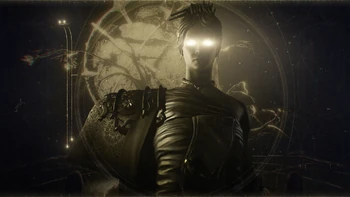
One can draw a parallel with the myth of Atlantis, in which the Atlanteans possessed advanced technology and eventually saw their kingdom sink, receiving punishment from the gods in their case.
The concept of a creative people is reflected in that of the Orokin, sometimes referred to as the Ancients in certain fictional universes—a founding civilization. Possessing great knowledge and having even created the races of the world, they eventually disappeared.
In Warframe, the Orokin are, in a sense, almost like gods and are often regarded as such—a blend of the Atlanteans and the Ancients. They also share a common trait with the Aesir of Norse mythology. With the giants as their enemies, these gods perish alongside them after battling them during Ragnarök. The same thing happens to the Orokin after they repel the Sentients.
Warframes and their skins
Ash
There is a mythological reference to this Warframe in one of its forms, Tsukuyomi, which is named after the Japanese god of the moon.
Atlas

Specializing in earth-shaping, he bears the same name as the giant Atlas from Greek mythology, who was condemned to carry the Earth on his shoulders. Heracles encountered him during his quest for the golden apples of the Garden of the Hesperides. One of his helmets, Tartarus, takes its name from Tartarus, the deepest part of the Greek Underworld, where the most heinous criminals are held. Another helmet, Telamon, is named after the king of Salamis, son of Aeacus, brother of Peleus, and father of Ajax the Great.
Banshee

A Warframe specializing in sound-based attacks. This makes its name fitting, as the Banshee is a legendary creature known for its blood-curdling scream. One of its helmets is named Echo, the nymph associated with the myth of Narcissus.
Chroma

The three helmets owned by this Warframe are named after mythological monsters: Amaru (Amaroca or Amaracu), the Inca serpent or dragon; the Drac; and the Tarasque.
Ember

The Fire Warframe wears the Phoenix helmet, named after the immortal firebird featured in many myths.
Equinox

One of her skins is Megaera, who is Megaera, one of the three Furies of Greek mythology.
Excalibur

One of the game’s most famous Warframes is a starter Warframe that possesses certain sword-fighting abilities. Its name, Excalibur—King Arthur’s sword—is a reference to Arthurian legends. Additionally, other names in the game, such as the helmets Avalon, Mordred, and Pendragon, also draw from these legends.
Frost

Associated with ice, Frost possesses the Jotun helmet, named after the Jötunn, giants from Norse mythology.
Garuda

A Warframe endowed with raw power and fearsome claws, named after Garuda, the legendary bird of Hindu mythology and slayer of nagas. It also features a helmet and skins named after Tiamat, the primordial Sumerian goddess.
Grendel

This massive, all-consuming Warframe is named after the ogress defeated by the hero Beowulf.
Hyldrin

It draws on Norse mythology through two skins: Sigrun, named after one of the Valkyries mentioned in the Edda, and Einheri, the Old Norse singular form of Eiherjar, the heroes chosen for Valhalla.
Hydroid

As her name suggests, this Warframe is associated with water and the oceans. One of her skins is named Poseidon, after the Greek god of the seas. She also has the Karkinos helmet, named after the giant crab that Heracles encountered during his Twelve Labors, and Triton, the sea god and son of Poseidon and Amphitrite.
Inaros

With his Egyptian-inspired design, Inaros has three helmets named after gods: Horus, Osiris, the god of the dead, and Anubis, the god of the underworld.
Ivara

While the name of the archer Warframe does not refer to any legend, there is one in her backstory within the Cabinet of Curiosities. Ivara had to face a terrible monster named Myrmidon. This refers to the warriors under Achilles’ command during the Trojan War. One of her skins is named Youkai, a reference to the Japanese spirits known as Yōkai. Her Astrea helmet, meanwhile, is named after one of the Greek personifications of justice.
Khora

Her collection includes a helmet and a skin named after the Indo-Iranian god Mithra, who was later worshipped by the Romans.
Kullervo

The Warframe known as the Seven Sins takes its name from Finnish mythology. Kullervo is a boy who, after years of abuse, becomes a lawless and extremely violent individual. His fate is tragic, as he commits suicide after discovering that a woman he had raped was his sister.
Loki

Because this Warframe specializes in illusions and deception, it is named after the Norse god Loki, who is a master of these arts. Her skins include Erebus, the name of one of the rivers of the Greek Underworld (known as Érèbe in French), Incubus, derived from incubi, and Kodama, the name of a Japanese spirit that lives in a tree.
Mirage

The Harlequin in the game has three skins based on legendary figures: Kitsune, inspired by Japanese fox spirits; Morgana, from Arthurian legend; and Mithra (who also wears a helmet), the Roman god.
Nekros

Using spells to manipulate his enemies, Nekros can also summon the shadows of defeated foes back into battle or force them to hand over more loot. This Warframe’s powers and name are reminiscent of necromancy. Furthermore, in keeping with his connection to the dead, one of his helmets is named Charon, after the ferryman of souls in Greek mythology.
Nezha

Nezha appears in Chinese mythology as the leader of the celestial army, who was later deified. One of his skins, Yaksha, is named after a type of nature spirit in Hinduism.
Nova

Her cosmetics include a helmet and a skin named after Lamia, the princess of Phrygia from Greek mythology who became a demon.
Nyx

Specializing in the psyche, this Warframe is named Nyx, the primordial Greek goddess of Night. She has a skin named Athena, the Greek goddess of wisdom. She also has two helmet and skin sets: one named Pasithea, one of the Three Graces, and the other named Nemesis, the goddess of vengeance.
Oberon

A Warframe named after Oberon, the fairy king of medieval legends, made famous by Shakespeare in *A Midsummer Night’s Dream*. Its Wendigo skin takes its name from the creatures of the American wilderness.
Protea

The body-protecting Warframe Parvos has a deluxe skin named Caladrius, a legendary bird from the Middle Ages.
Returning

The origin of this Warframe’s name is pretty obvious, since it refers to spectres—and more specifically, to beings from the afterlife.
Sevagoth

His alternative name is Lucifuge, the name of a demon who, in occult beliefs, serves as the prime minister of the underworld.
Styanax

This Warframe, with its Greek-inspired design and equipped with a spear and shield, may be named after the character Astyanax. In Greek mythology, he is the son of the Trojans Hector and Andromache. He is therefore the grandson of King Priam and is mentioned in the Iliad.
Titania

At the heart of the Silver Grove quest, Titania is described in the game as a mischievous sprite. Her name might bring to mind the Titans of Greek mythology, but that is not the case. It is a reference to the character Titania, the Queen of the Fairies, who also appears in Shakespeare’s *A Midsummer Night’s Dream*. A reference that also appears in Fairy Tail with Erza Scarlet, nicknamed Titania the Fairy Queen.
Uriel
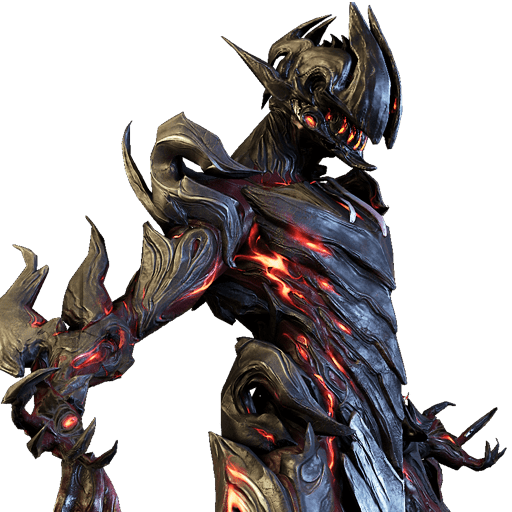
A fearsome Warframe who spreads the fires of hell with the help of his demons, Uriel is named after the archangel of vengeance in Jewish and Christian traditions.
Valkyr

While Valkyr’s description suggests little connection to them, her name nonetheless evokes the Valkyries of Norse mythology, who were tasked by Odin with selecting the warriors who would go to Valhalla. Her cosmetics feature the Roman god Mithra in her helmets and skins. She also has a helmet that blends Norse and Egyptian mythology. It is named Bastet, after the cat goddess, protector of homes and women.
Voruna

What could be better for this wolf Warframe than to bear the name of a Lithuanian forest goddess, Žvorūna, whose name comes from the word žvėris, meaning beast or wild animal?
Wisp

Its name is likely a reference to the Will-o’-the-wisp, the legendary will-o’-the-wisps that appear as flames.
Wukong

The name of this Warframe is quite evocative, as it is that of Sun Wukong, the Monkey King from *Journey to the West*. She also draws inspiration from him for her abilities, including her staff that can change size and her clones. One of her helmets is named Samadhi, a meditative state in Hinduism. He also features the Mithra set.
Zephyr

Specializing in the element of air, Zephyr takes its name from the personification of the west wind in Greek mythology, known by the same name (which is also sometimes spelled Zephyr). One of its helmets draws inspiration from Japanese legends featuring the Tengu, the raven-men.
Weapons and equipment
Centaur
The name of this melee weapon comes from the centaurs, the horse-men of Greek mythology.
Cronus
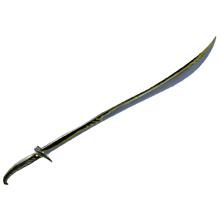
A sword associated with the Titan Cronus, father of Zeus and his brothers in Greek mythology.
Dex Pixia
These two sharp blades are named after pixies, meaning fairies. This is no coincidence, since they are the weapons of Titania, whom we saw earlier, and whose name refers to a Fairy Queen.
Gelatin
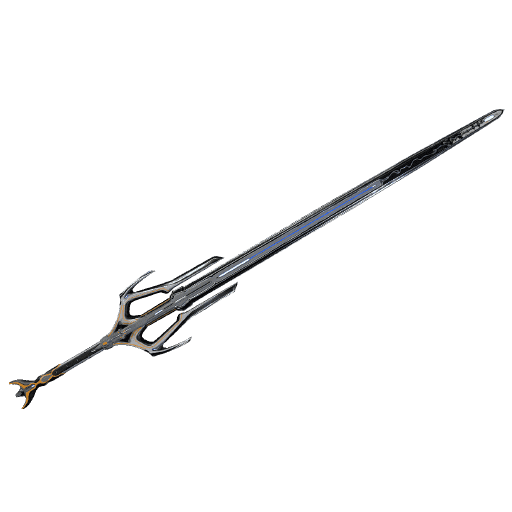
This two-handed sword takes its name from Arthurian legend; Galatine was the sword of Gauvain, a Knight of the Round Table.
Gorgon
Since the name of this weapon is in English, there are two related references. The first refers to the Gorgons of Greek mythology: Stheno, Euryale, and Medusa. The second possible reference is more directly to Medusa, who, after being cursed by Athena, was often called a Gorgon.
Gram
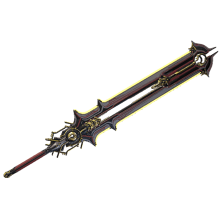
This powerful two-handed blade in the game takes its name from the legendary sword of the hero Sigurd (or Siegfried). Gram is also known as Balmung.
Kraken
Firing powerful projectiles, this pistol is named after one of the most famous sea legends: the Kraken, a fearsome monster capable of crushing and sinking any ship unfortunate enough to cross its path.
Ogris
A weapon that may simply be a reference to ogres, which are primarily found in fairy tales as child-eaters, but also in certain settings like Warhammer.
Orthos
In Greek mythology, Orthos is the two-headed dog who guarded the herd of the three-bodied giant Geryon, whom Heracles defeated.
Paris
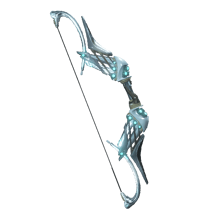
What could be better than naming a bow after Paris, the Trojan hero who killed Achilles with an arrow that struck his heel—his only weak spot?
Reaper
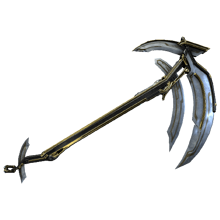
The name of this scythe can be translated as “reaper,” which makes it a reference to the Ankou.
Shedu
This assault rifle is named after a monster from Sumerian mythology, the Shedu or Lamassu—a winged bull with a human head.
Soma
This machine gun is named after soma, the sacred Hindu drink, which is highly alcoholic and induces a profound state of intoxication. One might speculate that the name was chosen because this weapon in the game has a large ammunition capacity, but it’s hard to say for certain that this is the reason behind the choice.
Spectra and Wraith
If we simply translate these two names, they simply mean “ghosts.”
Sybaris
The rifle is also known as Lamia or Lamie, the demon from Greek mythology who turned into a monster after Hera kidnapped and killed her children out of jealousy.
Zhuge
It is unclear whether this crossbow is named after him, but it certainly brings to mind the figure of Zhuge Liang, the legendary Chinese strategist who fought alongside Liu Bei during the War of the Three Kingdoms. Like many others who took part in that conflict, he has become a legendary figure.
Materials
Argon
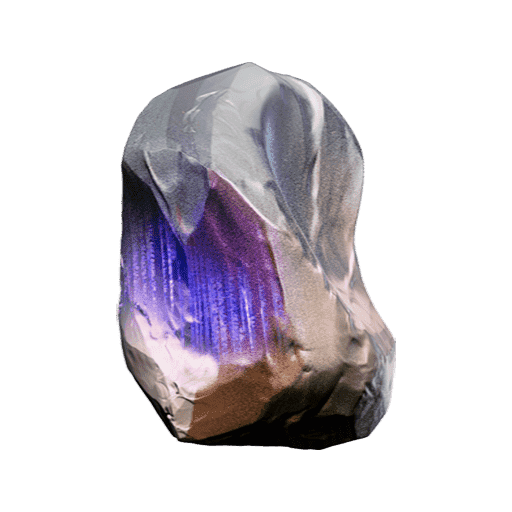
As a chemical element capable of undergoing natural transmutation, argon was studied by alchemists in their research.
Amaraste
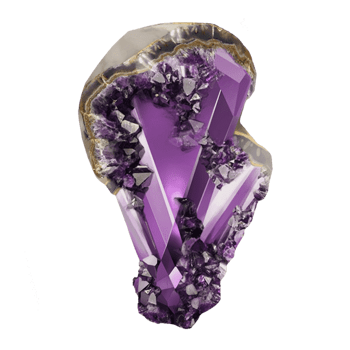
The name comes from the Chaldean, or Babylonian, numerological system.
Azurite
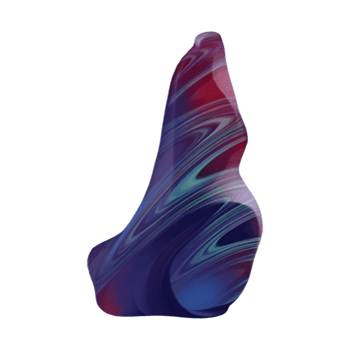
A semi-precious stone, azurite is believed to possess magical properties and was used in alchemy.
Gallium
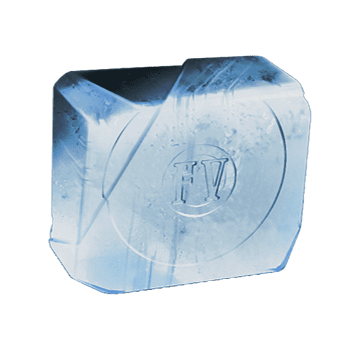
Another material used by alchemists who practiced the transmutation of gallium chloride.
Pyrotic
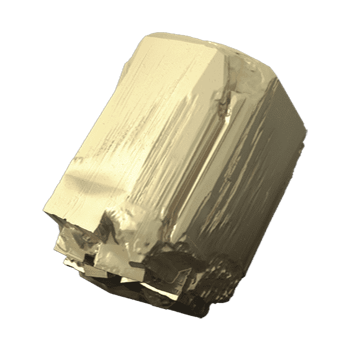
While this term is used in chemistry to refer to corrosive and caustic substances, pyrotic chemistry was a path pursued by alchemists.
Rubedo
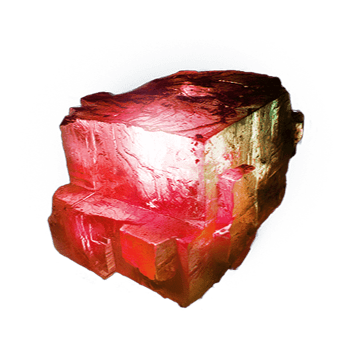
This is a reference to alchemy, and more specifically to the process of creating a philosopher’s stone.
The ships
Balor the Fomorian
A Grineer vessel, it is the most powerful of the Fomorian class, whose name derives from Celtic mythology and the Fomorians, the giants of the sea. As for Balor, the name comes from the king of the Fomorians in the myths.
Ivory Firbolg
This takes its name from the Firbolgs, a type of giant from Celtic mythology.
Ogma
This Grineer light vessel is named after Ogma of the Tuatha Dé Danann. He is the Celtic god of eloquence and the inventor of Ireland’s first writing system.
To learn more about Warframe lore, you can check out AriaSalty’s video series on the topic or VVhite Angel’s coverage of all the game’s content.
External links: official website
Images: Warframe Wiki official website