


Dernière modification le 27/07/2026.
Part of Arab mythology, jinns are fearsome legendary creatures.
Introduction
Jinn (جِنّ) appeared before the 7th century and the advent of Islam. They are very popular creatures in Arabian legends. Their name derives from “jin” (plural “jinni” and feminine forms “djinniya” or “jinniyya”), which comes from “jana,” meaning to hide, cover, or envelop.
They come in all kinds and in various forms; they possess spiritual and mental powers.
Islam attributes an origin to them: that of a smokeless fire, when man was created from clay with a destiny similar to that of other humans, and subject to the Last Judgment as an inhabitant of the earth.
“He created man from clay, like pottery;
He created the jinn from the flame of a smokeless fire.”– The Quran
Sometimes they are said to be divine creations that bridge the gap between angels and humans. Although they are best known from the legends of ancient Persia and its great texts, such as the Shahnameh, they also appear in Christianity and Judaism, under different names.
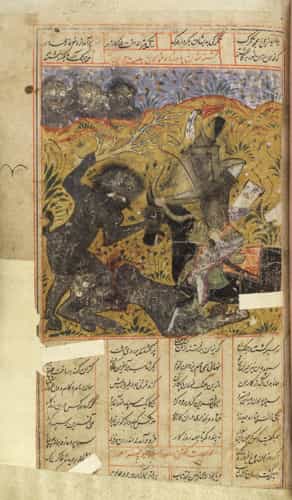
Description
The jinn live in tribal societies. Each clan has its own people, customs, territory, and religion. They are similar to humans in that, like humans, they eat, marry, have children, and die. They also possess free will and can choose to do good or evil, and to be believers or not.
Although generally invisible, jinns can also take on physical, plant, or animal forms. Most often, they are depicted as resembling demons. Sometimes they are described as having a vaporous or fiery body. Other times, they are hideous giants, with their feet on the ground and their heads in the clouds. There are about fifteen different types of jinns; the main ones are:
- Ifrits (or efrits), the fire jinns that live on land.
- the “marids” or “maritins,” those who live near bodies of water.
- the sylphs, those who fly and live in the heavens.

In Eastern folktales, genies are considered to be a type of jinn. In these tales, they can grant wishes to whoever is their master at the time, as in *Aladdin and the Wonderful Lamp* from *One Thousand and One Nights*.
They are, therefore, terrestrial creatures that live in deserts (where they cause sandstorms), near water sources, and in forests. As intelligent as they are malevolent, they sometimes mingle with humans by taking on their appearance. However, they do not speak the human language and have their own dialect; they are often exposed because of this, as well as by their behavior.

“It is the swarm of Djinns which passes,
— Les Orientales, Victor Hugo
And whirls whistling.”
In Morocco, there is a djinn who, taking the form of a beautiful young woman, seduces men at night to satisfy her sexual appetite. This is reminiscent of the succubus.
They are sometimes seen wandering through cemeteries at night; these are said to be widows who have been transformed into djinns for failing to observe the four-month-and-ten-day waiting period before marrying another man.
Powers
Above all, jinn possess spiritual and mental abilities that allow them to influence humans or take possession of them. They can also cause serious illnesses, known as sar, and those afflicted by them are called masru. Furthermore, people sometimes do not hesitate to strike animals at night for fear that they might be djinn.
When they strike a man, they can cause him to suffer physical or mental disabilities; they can lead to facial paralysis, hallucinations, epilepsy, and insanity.
Although they regularly torment people, they are harmless during Ramadan, when they are said to be held captive.
“No matter how old a djinn may be, it can still pull faces to scare children.”
– Wolof proverb
Protective Measures
To protect yourself from their evil spells, you must, of course, avoid isolated places at night where djinns might live, so as not to enter their territory. You must never provoke them, because they do not attack those who leave them in peace.
To protect oneself, one can sacrifice an animal at the entrance to one’s new home. One must not pour boiling water on the ground or down the drain, to avoid scalding a djinn and inciting its wrath. There is also a whole collection of psalms that one can recite.
To scare them away, you can fire a gun or play music with youyous. They are also afraid of daylight.
Someone possessed by a jinn can find out by consulting a psychic; they have the ability to see whether or not possession is present, and by what type of jinn. Psychics are also able to perform the ritual to exorcise the possessed person. This involves a kind of trance to expel the jinn from its host. But this is not a permanent solution, as it only works if an agreement is reached with the jinn. However, if this agreement is not honored, the jinn may re-possess its victim.
References
Literature: One Thousand and One Nights
Comics: Young Allies (Marvel)
TV Series: Djinns (M-J. Bou Chaaya, E. Dassani, R. Dassani)
Card Games: Magic: The Gathering (Wizards of the Coast)
Video Games: Guild Wars (NCSoft), Heroes of Might and Magic (New World Computing), Dota 2 (Valve)
External link (fr): when power leads to servitude (Science & Vie)
External link (en): Who are the supernatural beings of Arabian and Islamic tradition? (Middle East Eye)
Images: image 1 (Wikimedia Commons), image 2 (lenycherry_aiart)


