Now more than twenty years old, Eiichiro Oda’s One Piece saga has left its mark on an entire generation and continues to do so, as it is not yet over. While this pirate universe cannot strictly be classified as a work of fantasy, it nonetheless draws on legends and mythology.
As a reminder, *One Piece* follows the adventures of Monkey D. Luffy, a young boy who sets sail to become the Pirate King, accompanied by his crew.

Here you’ll find references that the author may have used to build his world (some of which are theoretical). Since One Piece is such a rich and detailed series, we’re focusing on the most direct references. We may have missed some, so please feel free to point them out in the comments.
Note: This article does not list all attack names that reference myths (as there are so many), but only the most interesting ones worth discussing.
East Blue Arc
Red-haired Shanks
One of Luffy’s character traits can be likened to the Norse god Tyr. In *One Piece*, Shanks sacrifices his arm without hesitation to save Luffy from a sea monster, just as Tyr, in Norse mythology, fearlessly sacrifices his hand to help the other gods trap the fearsome giant wolf Fenrir. Furthermore, Shanks proves to be a mediator in the Great War of Marineford, just as Tyr embodies this aspect as the god of justice.
Roronoa Zoro
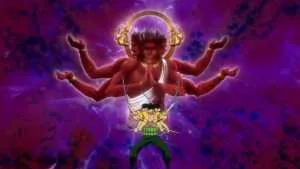
The swordsman of Luffy’s crew doesn’t exactly come across as a legendary figure in and of himself. However, his “Ashura” technique—which involves multiplying his limbs to perform multiple slashes at once—certainly is. It is named after Japanese warriors who died in battle and became guardians of Buddhist law. The Ashuras originate from the Asuras, the Hindu demons who are enemies of the gods, the Devas.
The Arch of the Warship Island
This special arc features a thousand-year-old dragon named Ryuji, whose name may be a reference to the Chinese sea dragon Ryujin.
Arc Little Garden
In addition to their resemblance to giants, the people of Elbaf also draw inspiration from the Vikings and Nordic culture as a whole.
Alabasta Arc
Pell and Chaka, prominent figures in the desert kingdom of Alabasta and the king’s right-hand men, are named after Egyptian gods. In their animal forms, thanks to their Devil Fruits, they resemble the gods Horus and Anubis.
In the episodes set in Alabasta, we also learn about the existence of ancient weapons in the One Piece universe. One of them is called Pluton, a reference to the Roman god of the underworld, whose Greek counterpart is Hades.
Nico Robin
If there’s one member of Luffy’s crew who resembles a deity, it’s Nico Robin. With her ability to multiply her arms and the names of her attacks based on flowers, she brings to mind Hindu goddesses. If we had to compare her to one in particular, Sarasvati seems the most likely candidate, as she is the goddess of knowledge and Nico Robin is a historian and archaeologist.
Skypiea Arc
The first reference in Skypiea is fairly obvious, since some of its people are angels. But there is also the python Nola, who is described as a normal snake that grew to gigantic proportions. Nola may be linked to the serpent Jormungandr from Norse mythology, who, like Nola, was small at birth but grew to gigantic proportions.
Furthermore, Skypiea’s main city, Shandora—a golden city built in the Maya style—is heavily inspired by El Dorado, a legendary South American city said to be covered in gold.
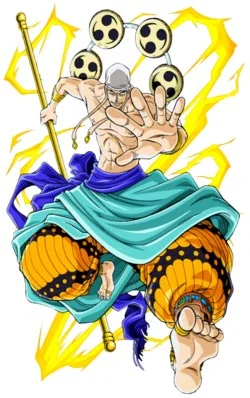
Finally, the antagonist of this arc is Ener, who, with his appearance, his drums, and his mastery of lightning, is reminiscent of the Japanese god of thunder, Raijin.
Arc Thriller Bark
During this arc, Luffy’s crew encounters gigantic black shadows at sea. This is a reference to the Umi-Bozu of Japanese maritime legends, which describe shadows that live in the sea and cause ships to capsize.
Upon arriving on Thriller Bark, they encounter a three-headed zombie dog at the entrance. This is a reference to Cerberus, the guardian of the entrance to the Underworld in Greek mythology.
At the end of the arc, Moria, the main antagonist, uses a technique called Asgard that absorbs the souls of his zombie warriors (who are, of course, dead). This is a reference to Asgard, the realm of the Norse gods, and indirectly to Valhalla, where the most valiant fallen warriors reside.
Amazon Lily Arch
The island of female pirates led by Boa Hancock is, of course, a reference to Greek mythology and the Amazons. All the island’s inhabitants, known as the Kuja Pirates, are women trained in combat who have little interest in men.
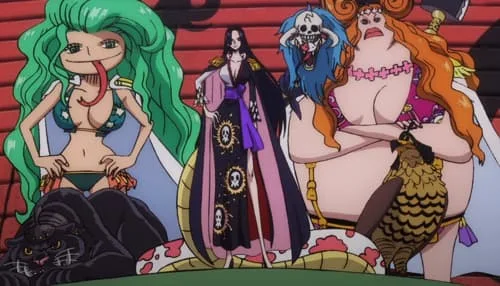
Boa Hancock and her Boa sisters also draw inspiration from Greek mythology. Their petrification powers and connection to snakes are inspired by the Gorgons, of whom Medusa is the best known. However, one of Hancock’s sisters, Sandersonia, is more closely associated with the Japanese mythical dragon Yamata-no-Orochi. It is an eight-headed dragon (like her when she transforms), and one of her attacks is named after the dragon.
Impel Down Arc
A terrifying prison in the One Piece universe, consisting of several levels, one of which is based on Naraka, the Hindu underworld. This level is covered in grass and trees with sharp leaves, just like the Sword-Leaf Forest of Naraka.
Magellan, the prison warden, is also named after a monster from Greek mythology. One of his attacks involves summoning a hydra and using its venom. This is inspired by the Lernaean Hydra, which was defeated by Heracles.
In addition, the prison guards include various mythological creatures: minotaurs, sphinxes, basilisks, and manticores.
Marineford Arc
The Emperor of the Seas, Whitebeard, has several lieutenants in his crew. One of them is Marco, whose power and nickname are linked to a well-known legendary creature: the phoenix, which is why he is nicknamed Marco the Phoenix.
On the Marine side, Admiral Kizaru draws upon Japan’s sacred treasures in his techniques. The Yata no Kagami shield is his teleportation ability, the Ame no Murakumo no Tsurugi sword is his light weapon, and the Yasaka(ni) no Magatama is his area-of-effect attack.
Fishmen Island Arc
There are several references to the sea deities of Greek mythology in this arc. The island is populated by tritons and mermaids, and its king is Neptune, the Roman name for the god Poseidon. We also hear about the second ancient weapon in the One Piece universe: Uranus. It is named after the Roman god of the sky, known as Ouranos in Greek mythology.
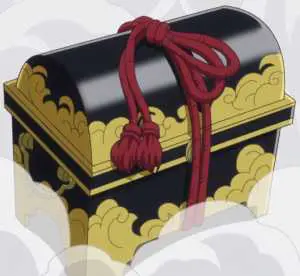
Another reference is to Otohime and the Tamatebako, a wooden box containing a mysterious treasure. This is a reference to the box of the same name from the tale of the fisherman Urashima Taro. After spending several years in the palace of the ocean, Otohime, the daughter of the Sea Emperor, gave him this box, which contained all the years he had spent with her. A box that was not to be opened, but which Urashima Taro opened out of curiosity, causing him to lose all the years he had spent without aging in an instant.
There remains the legendary ship resting beneath the waters off the island. Named the Ark of Noa—a name that no doubt refers to Noah’s Ark—it was intended to save a pair of every living species from the Flood.
Punk Hazard Arc
This island is home to several mythological and legendary creatures: a Western dragon, satyrs, and centaurs, but most notably a harpy in the form of Monet and a Japanese dragon in the form of Mononosuke.
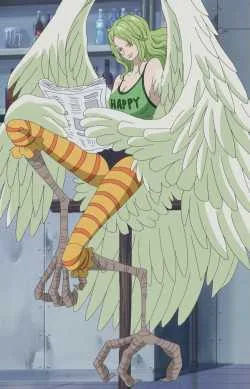
There is also Kinemon, known as the “Fire Fox“; his nickname and his ability to disguise himself are references to the kitsune of Japanese mythology.
Zou Arc
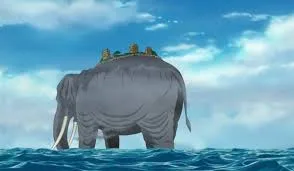
Here we discover the island of Zou, which lies on the back of the giant elephant Zunisha. While this may not be a direct mythological reference, the concept of a land carried by an elephant originates from Hindu mythology. In these myths, eight elephants (Airavata, Pundarika, Vamana, Kumunda, Anjana, Pushpa-danta, Sarva-bhauma, and Supratika) support the world.
Whole Cake Arc
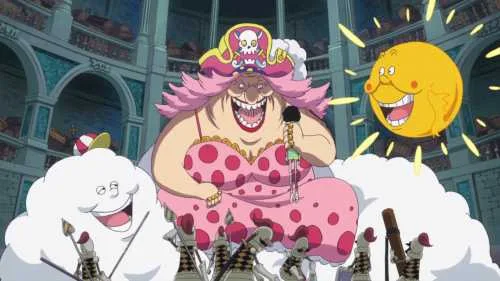
In this arc, Luffy and his allies face off against the fearsome Big Mom. She is accompanied by a cloud that can turn into a storm and a sun that can burst into flames, which serve as her familiars. They are named Zeus, after the Greek god of thunder, and Prometheus, the one who stole fire to give it to mankind. In a later arc, she creates Hera, named after the Greek goddess of marriage and wife of Zeus.
In this arc, one can also draw a parallel between the homies of the Forest of Temptation and their king, King Baum—who are animated trees—and the tree-men of legend (the Ents in Tolkien’s works).
Wano Kuni Arc
We can see a reference to the oni, horned giants, in the character of Kaido. Kaido also shares with Mononosuke the ability to transform into a Chinese dragon. Furthermore, Kaido resides on the island of Onigashima, which shares the same name as the island where the hero Momotarō battled demons in his legend. Among other locations, we can mention the village of Ebisu (where all the inhabitants laugh constantly), which is named after one of the seven deities of happiness.
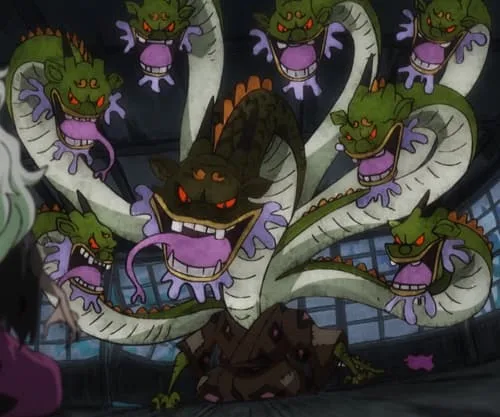
Another example is the character Kurozumi Orochi, who not only bears the name of the fearsome eight-headed dragon Yamata-no-Orochi—defeated by Susanoo—but also possesses the power to transform into the same form as him. There is a reference to Susanoo’s plan to defeat the dragon during Kosuki Oden’s flashback, in which he attempts to defeat Kaido (who can transform into a dragon) while drunk.
Another key character in this arc, Yamato possesses the Inu Inu no Mi Devil Fruit. This fruit allows him to transform into Ōkuchi-no-Magami, the deified form of the Honshū Wolf. In legend, this wolf is a deity who protects humans.
Another example is Black Maria, a member of Kaido’s crew who is inspired by the Jorōgumo of Japanese folklore. She is a monstrously large spider capable of transforming into an alluring woman. She takes great pleasure in capturing men, only to devour them.
As for the items, the Enma katana, once wielded by Oden Kuzuki and later by Zoro, is a reference to Enma, the Japanese god of the underworld.
Egghead Bow
The arc dedicated to Dr. Vegapunk includes a few references. Among the satellites is “Atlas,” the name of the giant from Greek mythology who carried the Earth on his shoulders. The second name is “Lilith,” the first woman, who became the mother of demons.
Next come the five elders who appear during the arc, each possessing a Devil Fruit associated with a Yokai or a legendary monster. Thus, Saturn has the Gyuki (a bull-headed monster), Mars the Itsumade (a reptilian bird), Warcury the Hoki (a bird), Nusjuro the Bakotsu (a skeletal fire horse), and Peter the Sandworm (a sandworm).
Elbaf Arc
The Elbaf arc takes us to the land of giants, whose Nordic origins bring them to mind as the Jötunn. As a result, there are numerous mythological references throughout.
Adam’s Tree, which stands at the center of the scene, is thus reminiscent of Yggdrasil, the World Tree, which supports the nine worlds of Norse mythology. There is also a region in Elbaf—a snow-covered underworld—that resembles Jötunheim, the realm of frost.
It is also mentioned that criminals from Elbaf are sent to this region. This may be a reference to Nibelheim or Helheim, the realm of the dead. There, Luffy meets Loki, who shares the same name as the god of deception and, like him, is chained to the trunk of the World Tree. Furthermore, his Devil Fruit allows him to transform into Nidhögg, the serpent that gnaws at the roots of the World Tree. The squirrel Ratatosk is mentioned in the backstory of this Devil Fruit.
We learn that the giants travel throughout their realm via rainbows, which is reminiscent of Bifröst, the bridge connecting Midgard, the realm of men, and Asgard, the realm of the gods.
As the crew tries to escape the Land of the Gods, the giant raven Muginn intercepts them. His name is reminiscent of Munin, one of Odin’s ravens.